Calculating Distances

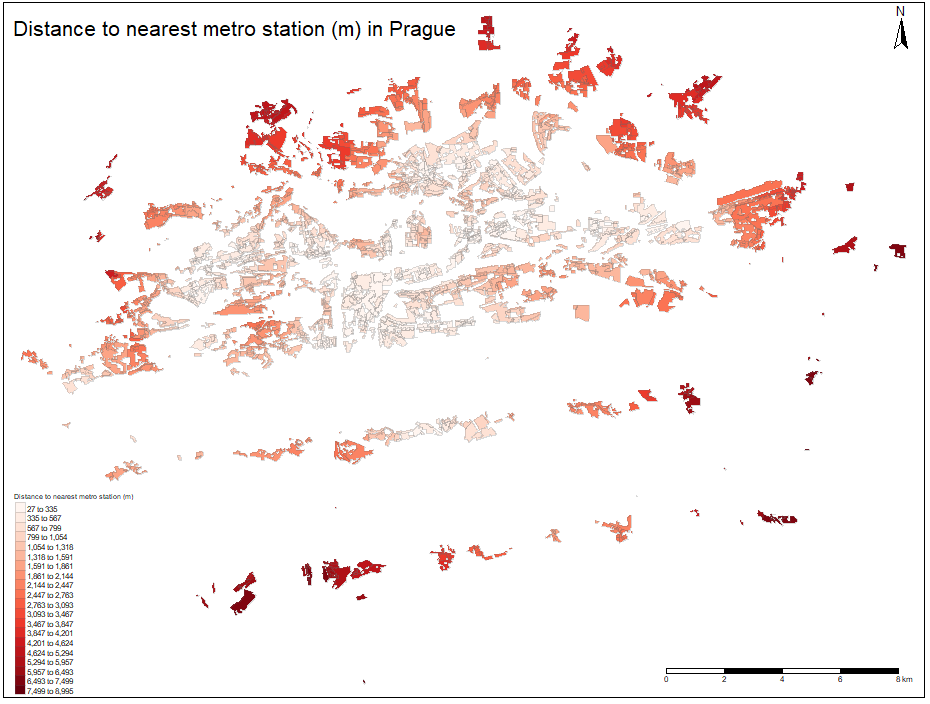
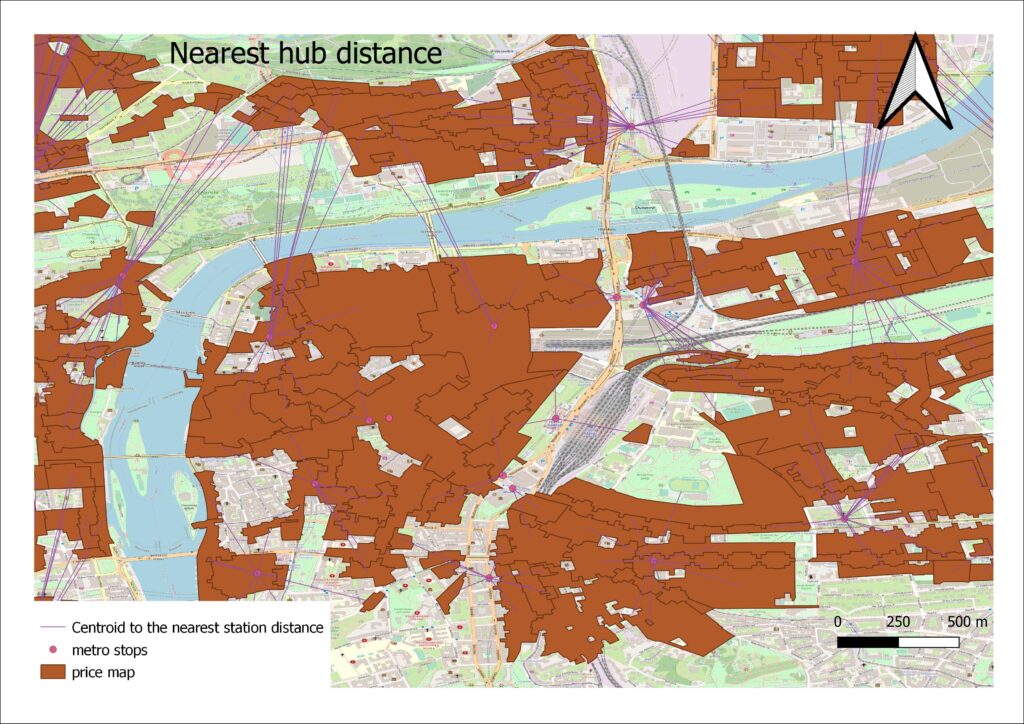
Using distance to nearest hub function in QGIS, for each public transport stop layer, the nearest hub distance to the centroid of each polygon is obtained. The snapshot from the nearest metro station distance output is plotted on the figure on the next page. The same procedure is applied to Tram,Train and Bus stops and by using spatial join, each hub distance is assigned to corresponding polygon. After converting the area of the polygons to square meters, all variables from the model scheme are obtained and the project will proceed with empirical data analysis.

 

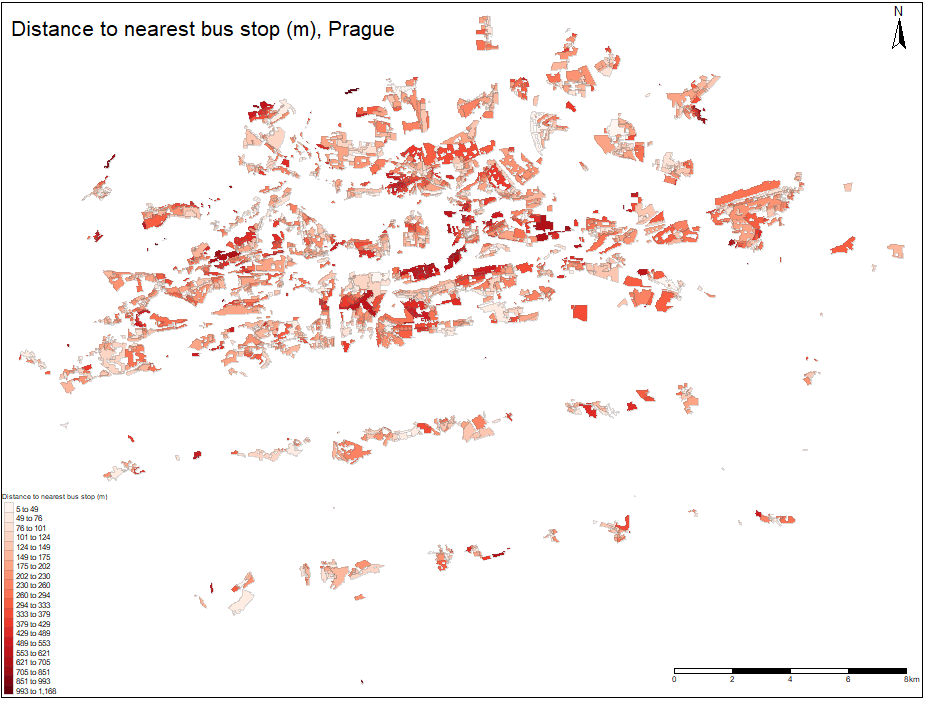
Nearest bus stop spatial distribution

The spatial distribution of the nearest bus station distances for each polygon is depicted on the figure below. When comparing with tram and metro distances spatial distributions, the values for buses seems to be more randomly scattered, as there is no relatively low value cluster in the historical center or any apparent pattern, related with the distance to historical center. However, the comparison with previously inspected modes is not so accurate as the values‘ range is approximately eight times lower when comparing with tram and metro. It corresponds to the fact, that the bus network is way more densed as it can be observed on the figure.

Nearest bus stop spatial distribution

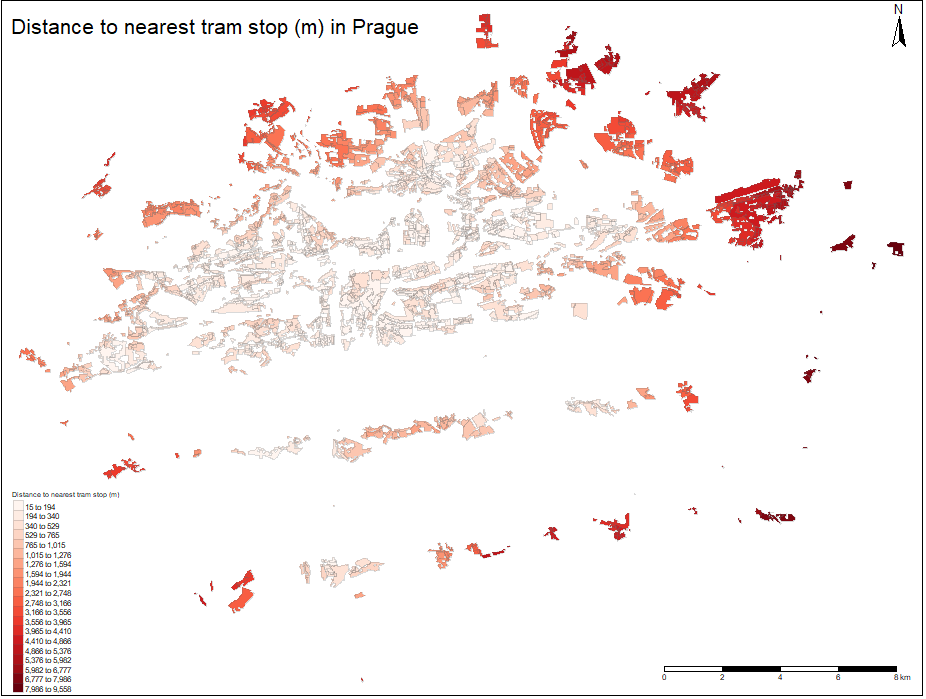
Nearest tram stop spatial distribution

Spatial distribution of the nearest tram distances is plotted below. When comparing with metro, similar pattern can be observed. However, more areas along the river seems to be better connected to the tram network. On the other hand, when inspecting the outskirts of the city, north-eastern part seems to be connected better to metro network. Compared with metro, the opposite can be observed on the western border of the city where the areas seems to be better connected to the tram network, as the distances are lower.

Nearest tram station distance spatial distribution

Nearest metro station spatial distribution

On the figure below, spatial distribution of the nearest metro distances for each polygon is plotted. The lowest values can be seen on the eastern bank of the Vltava river. By visual observations it can be concluded that the distance to nearest metro station is increasing with increasing radius from city center as the lowest values can be observed there. This development makes perfectly sense from the historical point of view as well as the stations were build initially in the center with so called switching triangle (stations Můstek, Muzeum, Florenc). This concept of development was typical in many former Eastern Block cities  1. For better insight, watch the referenced animation 2.

Nearest metro station distance spatial distribution

Area

As the land area can be observed directly from any other plot, the figure is not included. By visual observation it seems that the largest polygons are located on the city outskirts rather than in the city center. This corresponds with the urban design as the city center contains mostly historical apartment blocks whereas on the outskirts large concrete panel housing estates, especially on the eastern (Černý Most) and southern (Jižní Město) tips were build in the past 60 years 1.

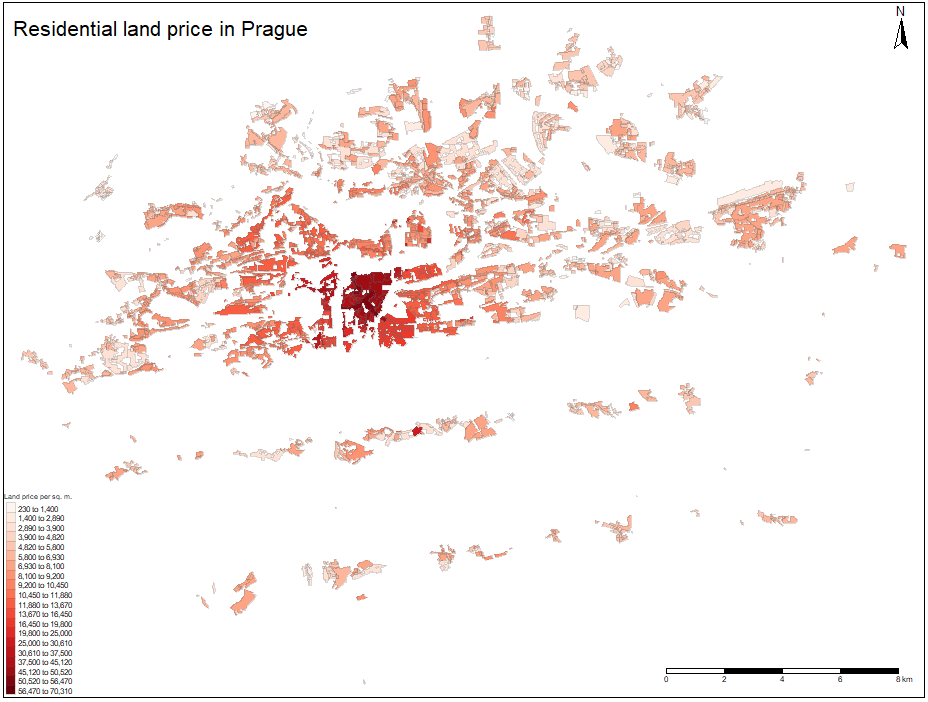
Residential land price spatial distribution

Starting with the analysis of price, figure below depicts the spatial distribution of residential land prices in Prague. One can see that the most valuable land is clustered arround historical city center whereas the least prices per square meter can be found on the outskirts of the cities. By observing the map, it seems that there is significant cluster of lower value land in the northern part of the city, in the Bohnice Municipality. It might correspond with the fact that this part of the city does not have any tram or metro stop nearby and it is available only by bus. This assumption will be further tested.

Residential land price spatial distribution

Summary Statistics

To investigate all values, summary statistics table of the dataset is printed below. Minimal value of price seems to be outlier as it is more than 20 times smaller than 25% quantile. The mean price is approximately 17% larger than median, indicating strong influence of large value observations. Regarding the area, the observation with minimal value has the same properties as the price as it is same polygon. The increase is much steeper, as the mean area is 2.31 times larger than the median. When investigating the distances, the smallest value with almost 5 meters is the minimal value of the nearest bus distance. Such small value does not seem to be realistic, however it is a payoff for the way how the distances were calculated. For the maximal values of distances, it can be observed that some areas are disconnected to the rail modes as the highest distance for metro, train and tram are not in walk-able radius. Overall, the variables will be further analysed in following sections, taking spatial properties into consideration.

Sumarry statistics of the dataset

Price (CZK/sq. m)Area (sq. m)Dist. Bus (m)Dist. Metro (m)Dist. Train (m)Dist. Tram (m)
Min.2304994.91727.0758.6614.58
1st Qu.50305617122.926626.03810.33249.34
Median678011920188.8421329.311295.79610.09
Mean795927541219.4751749.881491.611386.76
3rd Qu.883026695276.7572459.981862.382041.12
Max.703106252351167.9308994.617533.059558.25


Data Processing – Price Map Dataset filtering

To obtain residential land only from the Price map it is necessary to find out which polygons corresponds to residential usage.
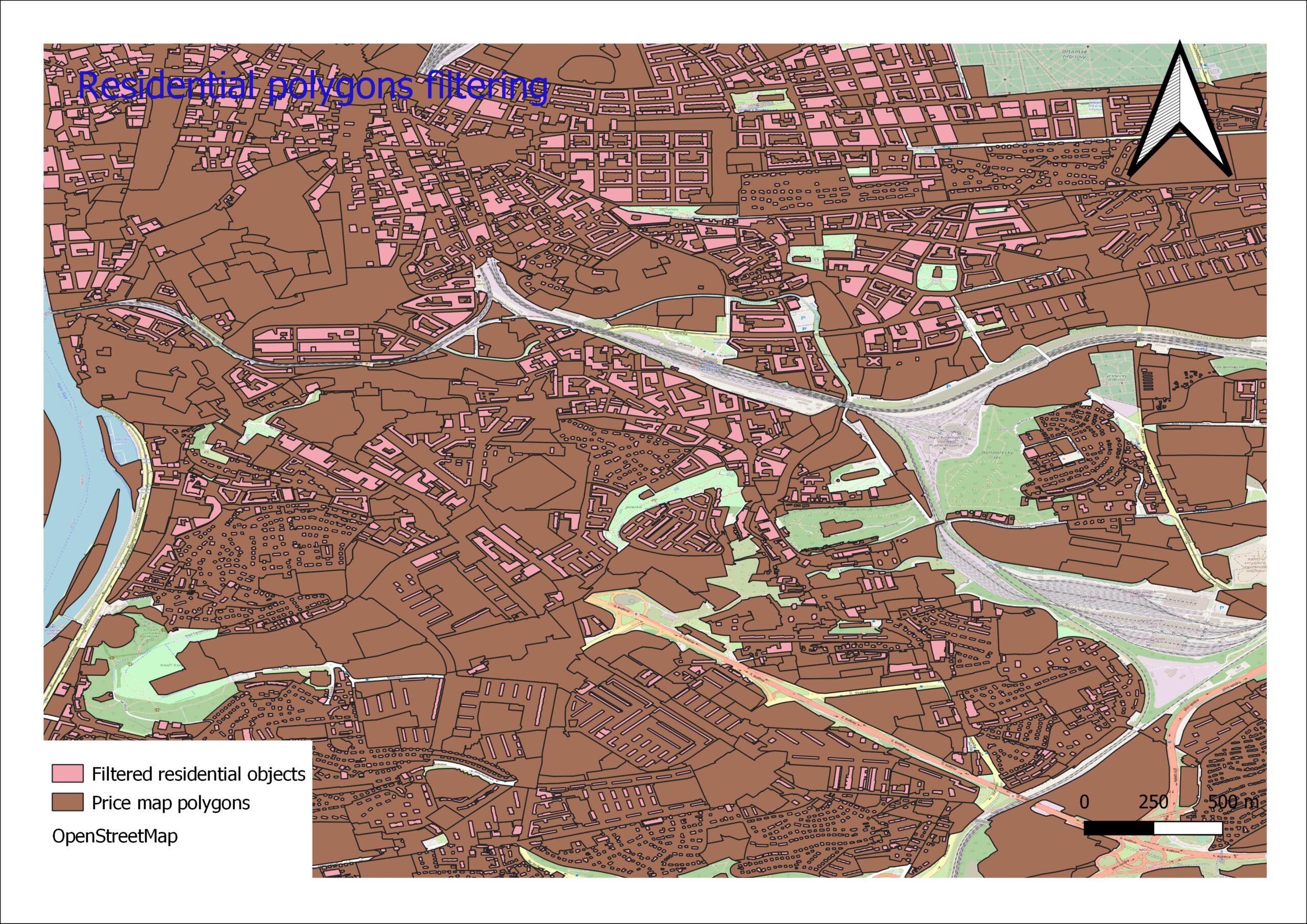
Area Usage Plan spatial dataset from Institute of Planning and Development is used 1 to label residential polygons. This dataset contains vector polygons with encoded type of usage of the areas. For the analysis, following types of areas was used – pure residential, general residential, general mixed, city core mix. The snapshot from filtered output is plotted on the figure.

Filtered output snapshot

To obtain price map polygons for residential areas only, Extract By Location process in QGIS, with geometric predicate „contains“ is used as shown on the figure.

Extract by Location

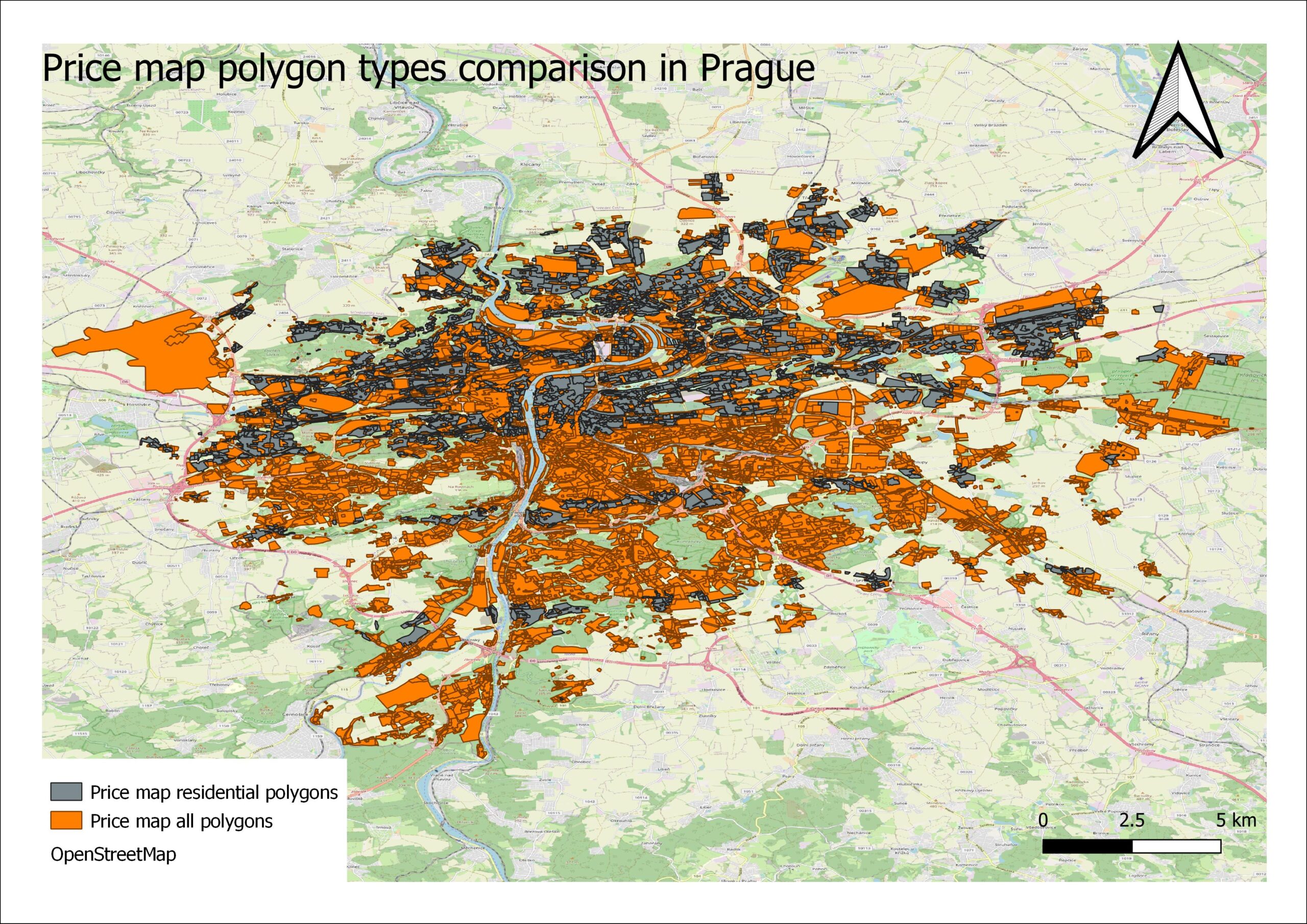
The final output is the Price map of residential areas. Each polygon represents residential or mixed area with price per square meter attribute. It represents approximately 35\% of all polygons, comparison between the original price map dataset and residential price map is depicted on the figure below.

Price map polygons comparison

Problem Statement

One of the most important indicator that affects the housing market in large cities is availability of connection to public transport system.
The aim of the project is to inspect the relationship between the residential land price per square meter and availability of public transport. The state of the housing market reflects the value of assets, including land and buildings. The availability measuring metrics will be determined as the distance to nearest public transport terminal. The transport modes that will be used in the analysis are Metro, Tram, Bus and Train.
Altough Prague’s integrated transport system contains cable car and river boats, these means of transportation are not included in the analysis due to the very low service coverage compared with above mentioned modes. As the aim of the project is to investigate how the transport availability affects the residential land price, the demographic characteristics, such as population density, are not included in the analysis.
To better illustrate the problem, a schematic illustration of the model is depicted below.

Model Scheme

Data Collection

The main data source for the analysis is Price Map obtained as an open data source from Prague Institute of Planning and Development 1. The Price Map is spatial database that contains vector polygons with price attribute. The price attribute is understood as price of land per square meter. However since it does not specify whether the land use is residential, commercial or other, it will have to be further processed to filter out non residential areas. All data that will be used in the analysis are listed below.