This series of articles will be focus on the analysis of Brazilian ecommerce public dataset of orders made at Olist Store.
The dataset has information of 100k orders from 2016 to 2018 made at multiple marketplaces in Brazil. Its features allows viewing an order from multiple dimensions: from order status, price, payment and freight performance to customer location, product attributes and finally reviews written by customers. We also released a geolocation dataset that relates Brazilian zip codes to lat/lng coordinates.
This is real commercial data, it has been anonymised, and references to the companies and partners in the review text have been replaced with the names of Game of Thrones great houses.
Dataset
https://www.kaggle.com/olistbr/brazilian-ecommerce
This dataset was generously provided by Olist, the largest department store in Brazilian marketplaces. Olist connects small businesses from all over Brazil to channels without hassle and with a single contract. Those merchants are able to sell their products through the Olist Store and ship them directly to the customers using Olist logistics partners. See more on our website: www.olist.com
After a customer purchases the product from Olist Store a seller gets notified to fulfill that order. Once the customer receives the product, or the estimated delivery date is due, the customer gets a satisfaction survey by email where he can give a note for the purchase experience and write down some comments.
Attention
- An order might have multiple items.
- Each item might be fulfilled by a distinct seller.
- All text identifying stores and partners where replaced by the names of Game of Thrones great houses.
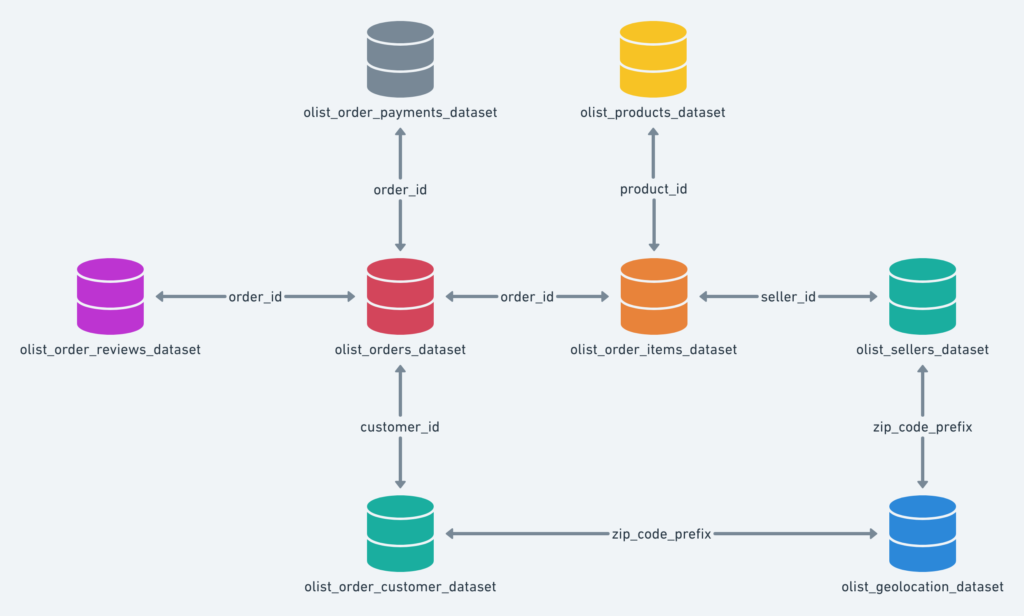
Data Schema
The data is divided in multiple datasets for better understanding and organization. Please refer to the following data schema when working with it:
Research Questions
There are tons of interesting questions a data scientist can answer with this dataset, but our aim is to find useful models for boosting ecommerce sales. So we are going to focus on the followings questions:
- Can we apply sentiment analysis on the reviews dataset and predict if the text is positive or negative, so we can compare it with the score?
- Can we build a smart recommendation algorithm, using hyperparameter optimization, for the list of related items for every product?
- How much shipping costs affects total sales?
- Is it possible to use prediction models in order to predict the future sales?